
Jefferson County Tax Record Fields
The Assessor and the tax office answer different questions. The Assessor's roll describes each parcel, sets its taxable value, and applies any exemptions. The Sheriff-Treasurer's Tax Office records the charges, payments, and receipts on the account. A value on an assessment card says nothing about whether the bill is paid. A receipt, in turn, never changes the property characteristics the Assessor lists. Always identify which office owns the field before you dig. The tax office offers an online tax-record search and payment service. Its exact form fields and result screens are best confirmed through the official portal or by calling staff, who can say which parcel or receipt identifiers the system currently accepts. The Assessor's assessment facts sit on one side of the ledger. Tax charges and payment status sit on the other. Treat them as two records that support one parcel.
| Field | What It Shows | Where |
|---|---|---|
| Land and improvement values | Assessment components used in value review | Assessor search; exact live card not inspected |
| Assessed value | West Virginia generally uses 60% of fair market value, subject to stated exceptions | Assessor roll |
| Tax class and land use | Parcel classification fields available in the state search | Assessor search |
| Exemption flags | Check what is applied to the parcel; current exemption list not verified | Assessor office |
| Bill and payment | Amount due, receipt, or delinquency status to confirm | Sheriff/Treasurer online system or office |
An assessed value is a tax measure, nothing more. A deed's stated consideration reflects a past transaction, while the tax bill flows from the assessment and the levies that apply to it. For the live parcel-card value history and the last revaluation year, check the current Assessor record rather than comparing older figures.
Find a Jefferson County Tax Bill
The Sheriff-Treasurer's Tax Office sits at 110 North George Street. It is open weekdays from 9 a.m. to 4:45 p.m. The published phone number is 304-728-3220. When a balance question outlasts the online record, have details ready before you call. Gather the tax year first. Add the parcel or receipt details too. Use the parcel number whenever you have one. The tax search form may not accept the same name, address, or map-number filters as the Assessor portal. Confirm its current field list with staff. The Sheriff/Treasurer page links an online tax-record search and payment service. The portal's exact query options and historical coverage vary. Verify the balance with the office directly for that reason. The phone number above reaches the staff who collect the payments.
- Find the parcel in the assessment system and copy its parcel ID and district.
- Open the tax search linked from the Sheriff/Treasurer office page and enter the parcel key.
- Review the displayed tax year, bill, payments, or delinquency fields, if available.
- Call the office to verify an amount due or sale status before relying on the screen.
The county tax office page is the source for the current online lookup and payment route.
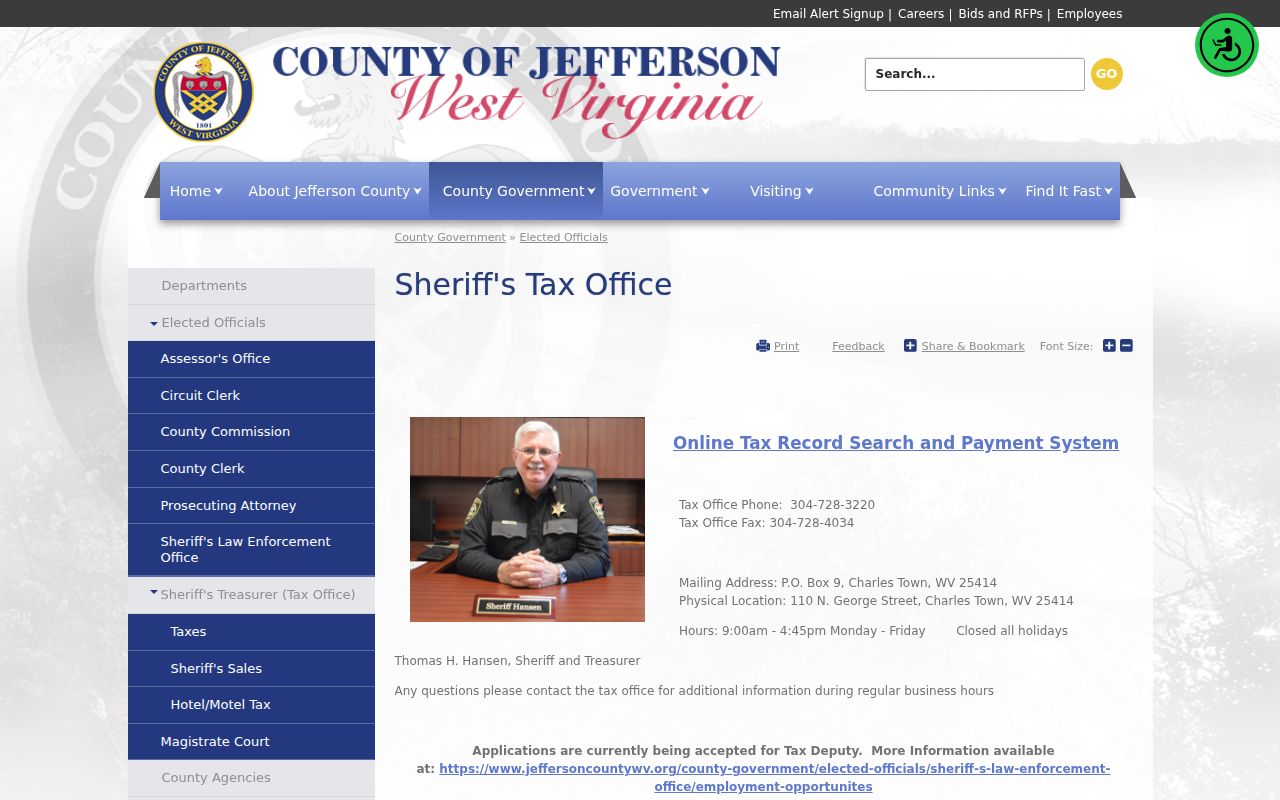
Check the official page first. Confirm the live tax search link, office hours, and contact number before sending any payment.
- Assessed value
- The value used for property taxation under West Virginia assessment rules.
- Tax bill
- The amount the tax office says is due for a tax period.
- Exemption
- A qualifying reduction applied under the applicable program; confirm local eligibility and status with the Assessor.
- Tax lien
- A claim tied to unpaid tax; verify any release or sale outcome in the official records.
Challenge a Jefferson County Assessment
Paying a bill and challenging an assessment are separate tasks. A question about condition, acreage, classification, or valuation belongs with the Assessor. Ask that office what evidence the current review cycle requires. The Board of Equalization and Review meets in February under the state process set out in W. Va. Code §11-3-24. Confirm current filing dates and instructions directly with the county. West Virginia law gives property owners that annual February path through the county commission. The statute references a 60% true-and-actual-value standard. The Assessor states that an owner may disagree with an appraisal. That owner may take the issue to the appraisal office. No Jefferson County appeal form or filing cutoff sits beyond the February board period. Call the Assessor or county commission for the present steps and dates. Good evidence speaks to the parcel and the value claim. Keep the assessment record, legal description, recent sale documents if relevant, and property-characteristics records together. A sale price does not automatically reset the assessment. A board review addresses the value on the roll. It does not decide whether a deed conveys good title.
Check the current calendar. The annual board review is associated with February under state law, but a local filing deadline and current appeal form were not verified. Contact the Jefferson County Assessor before relying on an old date.
Jefferson County Assessment Cycle
West Virginia assesses most property at 60 percent of fair market value. The rule sits in W. Va. Code §11-1C-1(d), with separate treatment for farm and managed timberland. The math is simple. A $100,000 market value yields a $60,000 assessed value under the state guidance example. That ratio links the two figures on a Jefferson County parcel card. It says nothing about what a particular home would actually sell for.
State law also sets a repeating inspection cycle. W. Va. Code §11-1C-9 calls for three-year cycles in which every parcel is visited to catch value-changing improvements and keep values current. So a physical review may not happen every year. That is a feature of the schedule, not an error. The county does not publish its last revaluation year or a full value history in one place.
To trace a change, open the statewide search's Appraisal/Sales view for the parcel. Then ask the Assessor whether the shift reflects a new improvement, a sale comparison, or the broader cycle. Before raising a correction, compare the card against a recent sale, the deed description, and current parcel conditions. The statewide framework explains the timing. It cannot vouch for any single card's accuracy.
Jefferson County Exemption Records
An exemption only lowers a tax bill after the right office recognizes it. Ask the Assessor which application and supporting proof fit the owner and parcel in question. Then read the property card for the recorded tax class and exemption status. A neighbor's classification proves nothing. Each parcel stands on its own record.
Agricultural and managed-timberland treatment follow their own statutory standards. Never infer eligibility from how land looks on the map. The same caution applies to general search snippets. A homestead, senior, veteran, or other reduction does not attach on its own. Its name appearing somewhere proves nothing. The Assessor's office holds the current Jefferson County exemption list, parcel-card labels, and application forms. It is the only place to confirm eligibility rules and deadlines.
Read assessment and payment records together when a bill looks off. Check the value and exemption fields in the parcel record first. Keep a copy of the notice and any submitted evidence. If a field looks wrong, contact the Assessor's appraisal office before anyone else. The February Board of Equalization and Review is the state-described county review step. It applies if the first conversation stalls.
Jefferson County Tax Delinquency Checks
A distressed-property review takes more than the tax office. Start with the Sheriff/Treasurer for the current tax receipt or delinquency. Then search the Clerk for a lis pendens, notice of sale, deed of trust, or later trustee deed. The Circuit Clerk handles civil case status and orders. Jefferson County posts a Foreclosure Notices link, though its searchable fields and archive depth go unlisted.
Read each document for what it is. A delinquent bill does not prove a tax sale happened. A foreclosure notice does not prove a transfer closed. Find the later recorded deed or court order before drawing conclusions. Confirm the current assessment owner separately. Keeping property tax records apart from title records keeps a payment screen from standing in as a land-transfer document.
Tax Value in Jefferson County Context
Three documents answer three different questions. Assessed value drives property tax under the state's general 60-percent rule. A bill shows what the tax office says is due. A deed or transfer instrument may show consideration from an earlier sale. None substitutes for another.
To compare figures rather than track a balance or appeal, use the separate Jefferson County property value explanation. Then verify the parcel's current values with the Assessor. For payment status, use the Sheriff/Treasurer system and resolve any uncertainty by phone.