
Jefferson County Property Value Types
Every value figure has a source and a purpose, so keep the two attached. The Assessor's appraised amount drives the county's assessment process. The taxable assessment applies state rules and any recognized exemptions. The tax bill then multiplies that taxable amount by the year's levy. A recorded sale price proves a transaction happened. But it is not the county's current opinion of value. An automated estimate from a commercial search provider may rest on a model. That model may have little in common with the assessor's. When two figures disagree, write down the date. Note the tax year, the land and improvement components, and whether each number is gross or taxable. That habit settles most confusion.
A property value might be an assessment amount. It could be a full-value estimate. It could also be the consideration named in a deed. Each comes from a separate process and a separate date. The Assessor's site describes its fair-market-value role and links Appraisal/Sales data. The live parcel card and its value-history fields stay inside the assessment record. So the table serves as a guide to where each number can be verified.
| Value | What It Is | Where |
|---|---|---|
| Assessed value | Tax value set under West Virginia assessment rules | Assessor roll |
| Market value | Fair market value used as the basis for assessment | Assessor appraisal work; exact live field not inspected |
| Sale consideration | Amount stated for a past conveyance, if shown | Recorded deed or transfer instrument |
| Land and improvements | Separate components to inspect in the parcel record | Assessor Appraisal/Sales view |
West Virginia generally assesses property at 60 percent of current fair market value under W. Va. Code §11-1C-1(d), with exceptions for farm and managed timberland. State guidance illustrates the math with a $100,000 market value yielding a $60,000 assessment. The assessed value is a tax figure, not a sale price. A populated Jefferson County parcel card may show additional sale-history fields. Open the live record to see them.
Jefferson County Assessed Value Search
The statewide West Virginia search offers Basic, Appraisal/Sales, Advanced, and Prior Ownership views. Pick Jefferson County, then search by street name, owner, or parcel. With a full parcel ID in hand, use the Map Number, Parcel, and Sub-Parcel fields. The Assessor's homepage links parcel viewers and appraisal data. It also links plats, historic maps, finished tax maps, and a county GIS shapefile.
The Assessor's official starting page and resource menu appear below. It is a directory, not a sample appraisal card. The value-history display and last-revaluation year live in the live assessment record, so confirm both there. The listed appraisal data, parcel views, plats, maps, and GIS resources anchor any property-value research in Jefferson County.
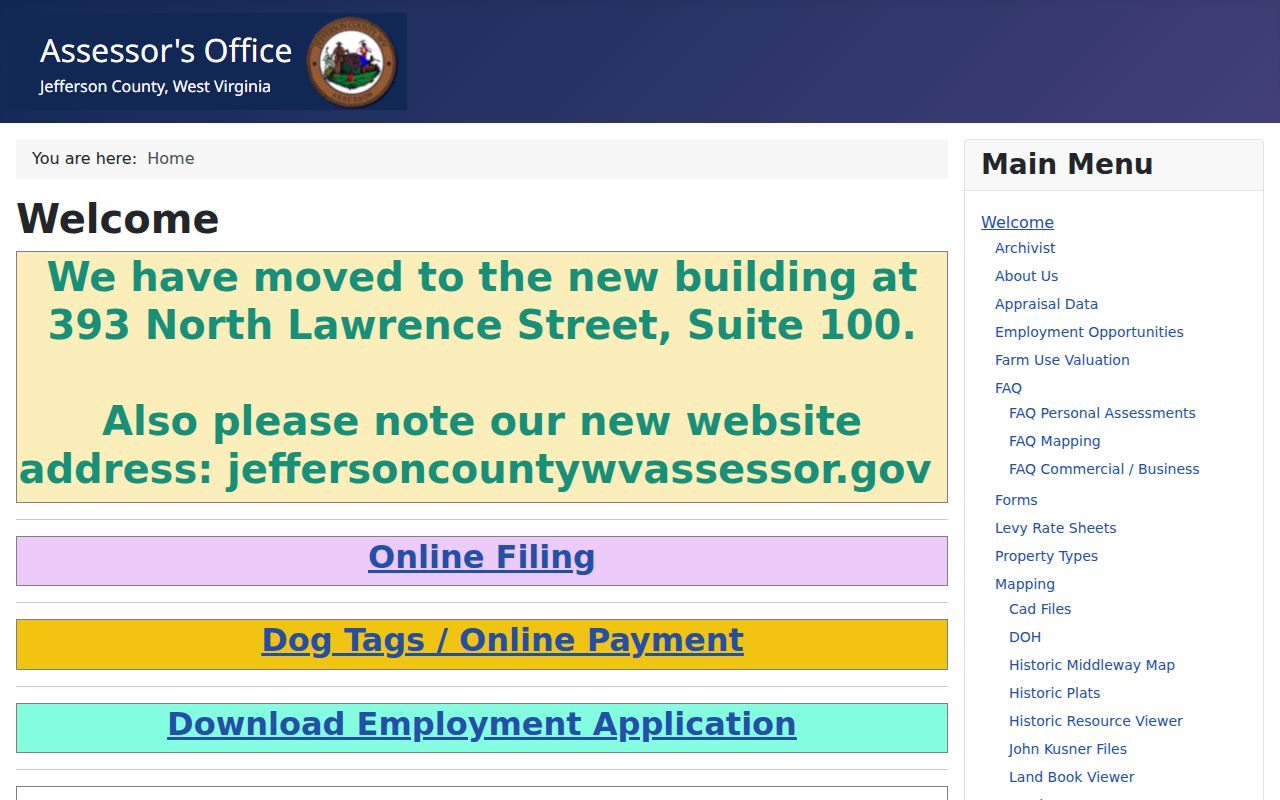
From that entry point, open the parcel's assessment record. Then note the tax year and the value fields the record actually displays.
Jefferson County Value Cycle
West Virginia generally assesses at 60 percent of fair market value. Farm and managed timberland are exceptions. Those categories follow separate statutory treatment. State law also builds in a repeating three-year inspection cycle. A displayed value is therefore not always a fresh physical appraisal. Before asking about a correction, check the parcel's current condition. Also review its recorded description and comparable documented sales with the Assessor.
The three-year cycle works like this: every parcel gets visited on a rotating basis. These visits catch value-changing improvements and keep assessments current. W. Va. Code §11-1C-9 describes it. The 60-percent level is just a conversion from fair market value into an assessment. It neither freezes a parcel's value for three years nor guarantees any particular change.
For a specific parcel's history, lean on the Appraisal/Sales view, the tax-year field, deed references, and dated notices. Check the Appraisal/Sales view first. If the record omits dates or a value change is unclear, ask the Assessor. Do not infer a countywide trend from one sale. A single deed rarely tells the story of Jefferson County as a whole.
Find a Jefferson County Assessment
Let the parcel key anchor the search to the correct tract. An address can point to several parcels, especially along a long road. Once the match is made, look for the assessed value in the current view. Also check for any land or improvement split. Keep the tax year beside each amount. Values and owner-of-record entries change over time, and a stale figure can mislead.
- Select Jefferson County and enter a street name, owner, or parcel identifier.
- Open Appraisal/Sales and note the tax year and assessment fields that are displayed.
- Use the deed reference to locate a recorded consideration amount, if the instrument states one.
- Compare the dates and descriptions; do not assume the past sale equals current market value.
- Assessed value
- The value used for taxation under state assessment rules.
- Market value
- The fair market value basis for assessment, not a guaranteed sale price.
- Assessment ratio
- The share of fair market value used for the assessed figure; West Virginia generally uses 60 percent.
- Sale consideration
- The amount stated in a conveyance, if recorded; it reflects a past transaction.
Jefferson County Sale Price Evidence
A sale only helps your case if it truly compares. Pull the recorded deed and confirm exactly what changed hands. Then weigh its parcel size, land use, improvements, and date against the subject property card. Family transfers, multi-parcel deals, and unusual terms can distort a price. They may not reflect the open market at all. The assessment portal has a Sales view. The deed itself and the Assessor's explanation settle any mismatch better.
Remember the timing. A sale price belongs to its deed and its transaction date. It is not a present-day valuation of the property. The County Clerk's recorded instrument is the transfer evidence. For assessment context, use the Assessor's Appraisal and Sales view instead. The displayed Last Sale or Consideration field may sit empty. Read the current parcel record before trusting any amount shown.
When a deed states its consideration, match the conveyed parcel first. Then match the legal description to the assessment record. A fiduciary deed rarely compares to a clean sale of the whole tract. A partial interest rarely does either. One recorded amount describes that single transaction. It does not appraise the property today.
Jefferson County Exemptions and Value
Anchor any value objection to documented facts. The parcel identifier belongs in your file. So do the assessed land and improvement amounts, the tax class, and a dated description of the condition at issue. Comparable sales can support the point. Match them to the subject's location, size, and improvements, though, or they cut against you. The Assessor can walk through the current card and exemption entry. The February Board of Equalization and Review remains the formal review route under state law. Ask the county for current filing instructions. Property-specific due dates are not published in one fixed place.
Exemptions work in a subtle way. They can lower a taxable amount while leaving the underlying assessed value untouched. Those fields live in the assessment review, not in a separate ledger. Jefferson County's current exemption list, parcel-card labels, and eligibility rules are not standardized across records. Check the live record and ask the Assessor which program applies to the parcel. Never assume a general exemption category is active.
Value questions are really about interpreting numbers. For a tax bill, an exemption application, or a formal assessment review, follow the separate Jefferson County property tax records instructions. They explain the Sheriff/Treasurer and the February Board of Equalization and Review in depth.
What Jefferson County Assessed Value Means
Assessed value and market value answer two different questions. The assessed figure feeds a statutory formula that produces your local property tax. A buyer and seller, by contrast, negotiate a real price in a live market. The Sheriff-Treasurer's office handles balances, due amounts, and receipts. It cannot touch the Assessor's land and improvement valuation. To challenge a valuation, gather the parcel ID, a copy of the card, and factual evidence about the property, then contact the Assessor before the February Board of Equalization and Review begins.
An assessed value exists for one purpose: taxation. It often diverges from what a buyer would pay. The date, method, data, and legal purpose all differ from a current market appraisal. A sale price may be stale. It might cover only a partial interest. And a mass appraisal record is never a substitute for a professional appraisal prepared for a specific sale or financing decision.
Value is not price. A Jefferson County assessed value is a tax measure, not what the property will sell for today. Obtain a qualified appraisal when a current market opinion is needed.